

A WW tandem-mediated dimerization mode of SAV1 essential for Hippo signaling
2020.09.08Lin, Z., Xie, R., Guan, K., & Zhang, M. (2020). Cell reports, 32(10), 108118.
The canonical mammalian Hippo pathway contains a core kinase signaling cascade requiring upstream MST to form a stable complex with SAV1 in order to phosphorylate the downstream LATS/MOB complex. Though SAV1 dimerization is essential for the trans-activation of MST, the molecular mechanism underlying SAV1 dimerization is unclear. Here, we discover that the SAV1 WW tandem containing a short Pro-rich extension immediately following the WW tandem (termed as “WW12ex”) forms a highly stable homodimer. The crystal structure of SAV1 WW12ex reveals that the Pro-rich extension of one subunit binds to both WW domains from the other subunit. Thus, SAV1 WW12ex forms a domain-swapped dimer instead of a WW2 homodimerization-mediated dimer. The WW12ex-mediated dimerization of SAV1 is required for the MST/SAV1 complex assembly and MST kinase activation. Finally, we show that several cancer-related SAV1 variants disrupt SAV1 dimer formation, and thus, these mutations may impair the tumor-suppression activity of SAV1.
- Recommend
-
2025-10-22
IQSEC2/BRAG1 may modulate postsynaptic density assembly through Ca2+-induced phase separation.
-
2025-08-22
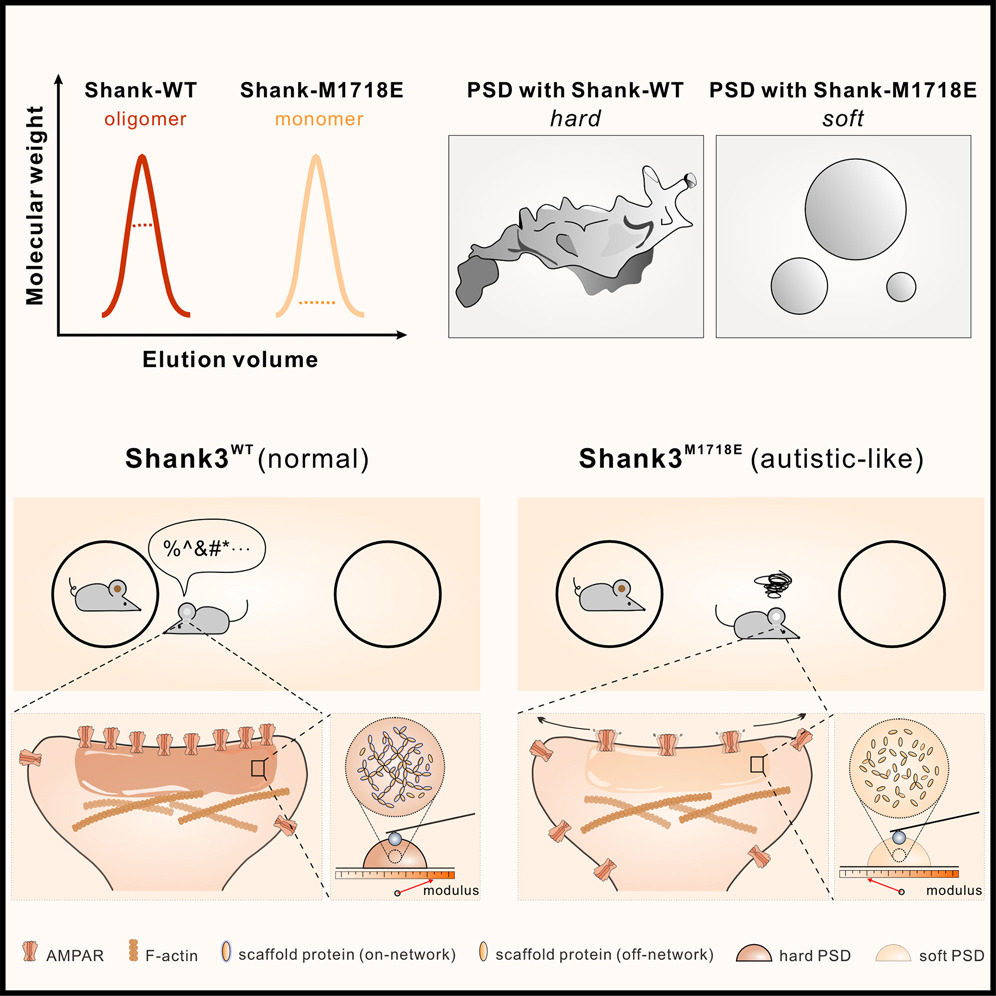
Shank3 oligomerization governs material properties of the postsynaptic density condensate and synaptic plasticity.
-
2025-08-21
Modulating synaptic glutamate receptors by targeting network nodes of the postsynaptic density condensate.
-
2025-08-19
Current practices in the study of biomolecular condensates: a community comment.
-
2025-06-10
Phase separation instead of binding strength determines target specificities of MAGUKs.