

Short-distance vesicle transport via phase separation.
2024.03.28Qiu, H., Wu, X., Ma, X., Li, S., Cai, Q., Ganzella, M., ... & Zhang, M. (2024). Cell.
In addition to long-distance molecular motor-mediated transport, cellular vesicles also need to be moved at short distances with defined directions to meet functional needs in subcellular compartments but with unknown mechanisms. Such short-distance vesicle transport does not involve molecular motors. Here, we demonstrate, using synaptic vesicle (SV) transport as a paradigm, that phase separation of synaptic proteins with vesicles can facilitate regulated, directional vesicle transport between different presynaptic bouton sub-compartments. Specifically, a large coiled-coil scaffold protein Piccolo, in response to Ca2+ and via its C2A domain-mediated Ca2+ sensing, can extract SVs from the synapsin-clustered reserve pool condensate and deposit the extracted SVs onto the surface of the active zone protein condensate. We further show that the Trk-fused gene, TFG, also participates in COPII vesicle trafficking from ER to the ER-Golgi intermediate compartment via phase separation. Thus, phase separation may play a general role in short-distance, directional vesicle transport in cells.
- Recommend
-
2025-10-22
IQSEC2/BRAG1 may modulate postsynaptic density assembly through Ca2+-induced phase separation.
-
2025-08-22
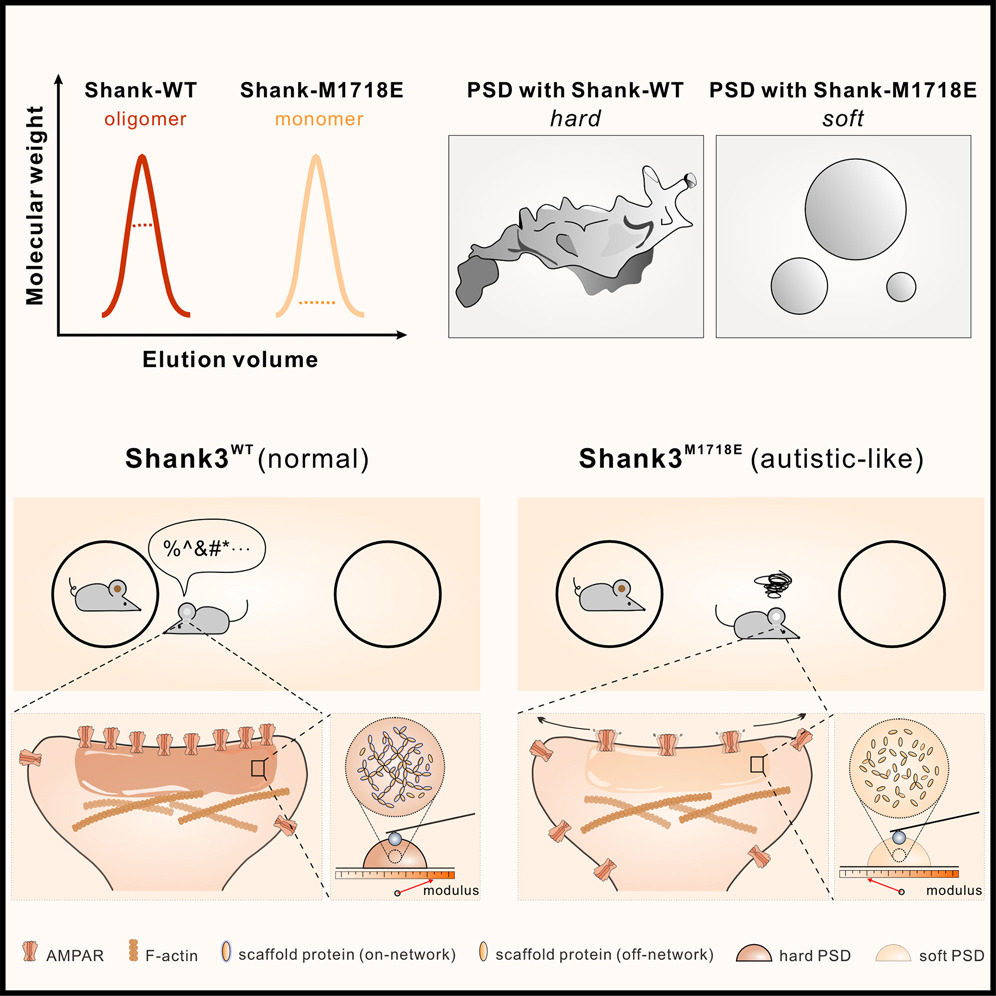
Shank3 oligomerization governs material properties of the postsynaptic density condensate and synaptic plasticity.
-
2025-08-21
Modulating synaptic glutamate receptors by targeting network nodes of the postsynaptic density condensate.
-
2025-08-19
Current practices in the study of biomolecular condensates: a community comment.
-
2025-06-10
Phase separation instead of binding strength determines target specificities of MAGUKs.