

Demixing is a default process for biological condensates formed via phase separation
2024.05.23Zhu, S., Shen, Z., Wu, X., Han, W., Jia, B., Lu, W., & Zhang, M. (2024). Science, 384(6698), 920-928.
Excitatory and inhibitory synapses do not overlap even when formed on one submicron-sized dendritic protrusion. How excitatory and inhibitory postsynaptic cytomatrices or densities (e/iPSDs) are segregated is not understood. Broadly, why membraneless organelles are naturally segregated in cellular subcompartments is unclear. Using biochemical reconstitutions in vitro and in cells, we demonstrate that ePSDs and iPSDs spontaneously segregate into distinct condensed molecular assemblies through phase separation. Tagging iPSD scaffold gephyrin with a PSD-95 intrabody (dissociation constant ~4 nM) leads to mistargeting of gephyrin to ePSD condensates. Unexpectedly, formation of iPSD condensates forces the intrabody-tagged gephyrin out of ePSD condensates. Thus, instead of diffusion-governed spontaneous mixing, demixing is a default process for biomolecules in condensates. Phase separation can generate biomolecular compartmentalization specificities that cannot occur in dilute solutions.
- Recommend
-
2025-10-22
IQSEC2/BRAG1 may modulate postsynaptic density assembly through Ca2+-induced phase separation.
-
2025-08-22
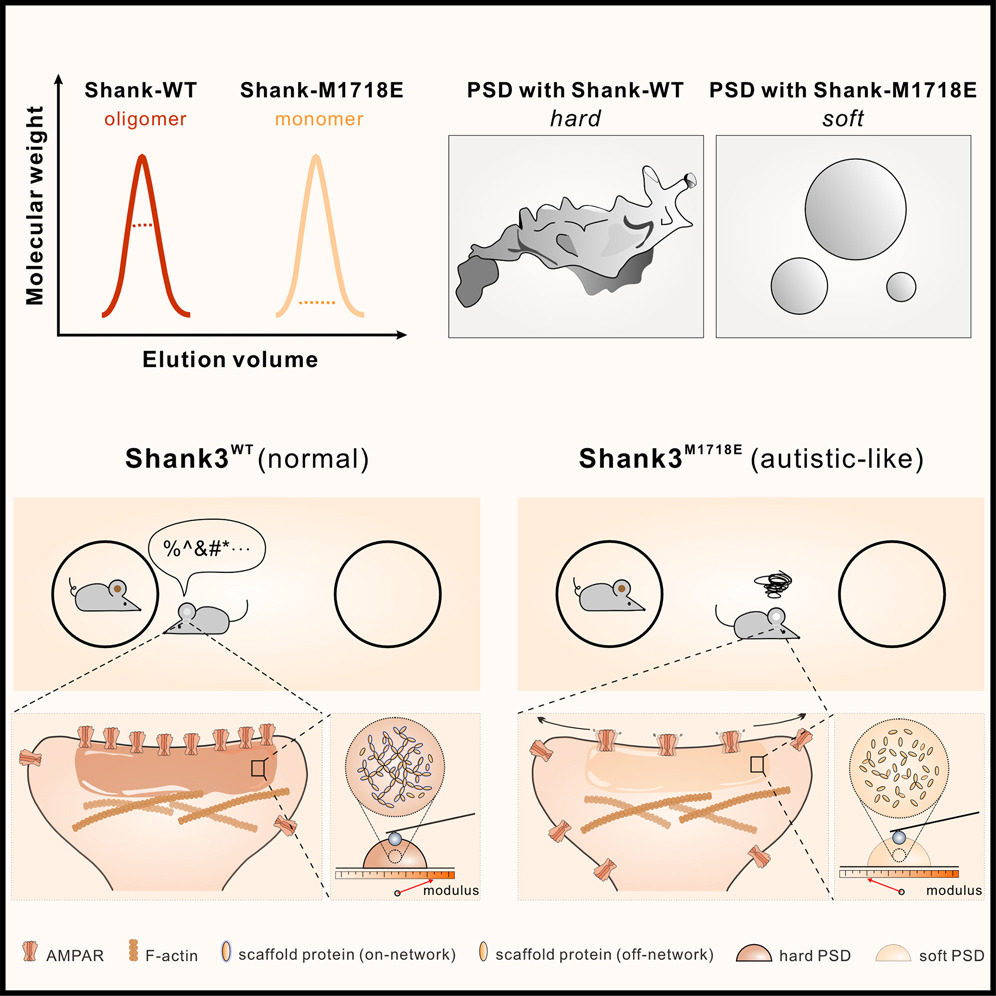
Shank3 oligomerization governs material properties of the postsynaptic density condensate and synaptic plasticity.
-
2025-08-21
Modulating synaptic glutamate receptors by targeting network nodes of the postsynaptic density condensate.
-
2025-08-19
Current practices in the study of biomolecular condensates: a community comment.
-
2025-06-10
Phase separation instead of binding strength determines target specificities of MAGUKs.